
Let’s discuss the Nigerian oil and gas sector from scratch, a simple ABCD approach that can give you the basic knowledge of Nigeria’s most lucrative industry. In the Nigerian oil and gas sector, we produce oil from a certain location and then export it to earn dollars, which would serve as revenue for the entire federation. How do you extract the oil?
Where is it located?
What are the licenses needed?
How does the industry as a whole relate to each other?
Those are some simple, generic questions that we may come to learn in the article. Skip to part 2 if you have read this part before.
How do you extract the oil?
You extract/produce crude oil from an oil well located inside an oil field that belongs to an oil block/acreage under a specific license/lease term (OML/OPL). Let’s explain the above statement by dissecting the below technical terms:
1. Oil Acreage/Block
2. Oil Field
3. Oil Well
4. Reservoir
5. Terminal/Stream
6. OML/OPL (Oil Mining Lease and Oil Prospecting License). One is “lease,” and the other is “license.” Or, using the new Petroleum Industry Act (PIA) terms,
OPL = PPL
OML = PML
Which replaced “oil” with “petroleum.” The word “petroleum” captures both oil and gas, while “oil” is just oil.
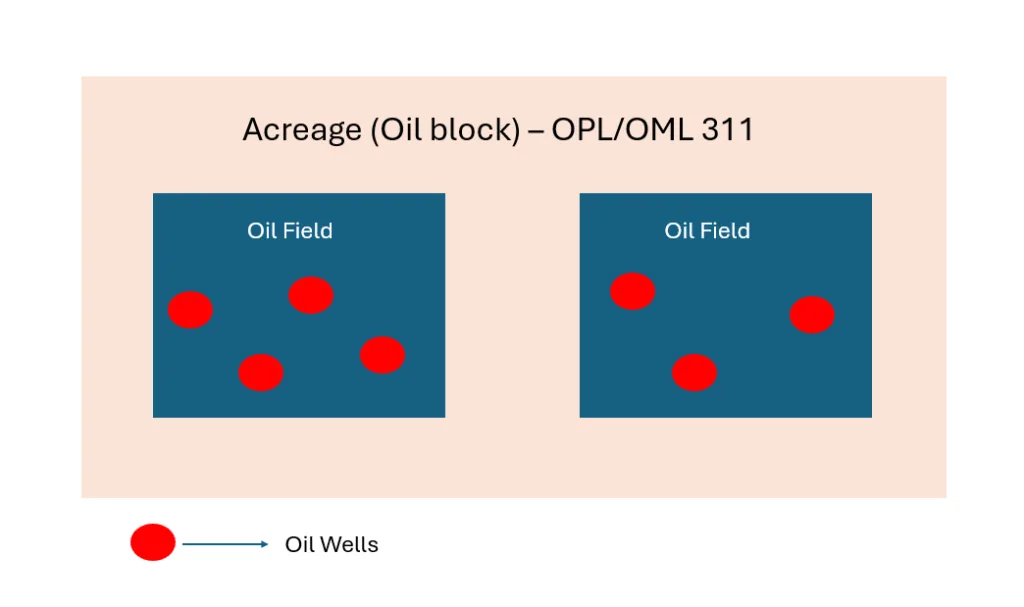
Where is it located?
1. Oil Acreage:
Oil acreage is otherwise called an oil block. “Acreage” is the standard name, but “block” is the most widely used term. Just like “gasoline” is the standard and proper name for “PMS” in Nigeria. For simplicity, we’ll be using oil block.
Oil Block is the land area where companies are allowed to explore for oil. Think of it like a school compound with many classrooms inside. It is a legal boundary, ring-fenced and authorized/recognized by the government. An oil block is tied to a license given to companies to search for oil. (OPL)
2. Oil Field:
This is part of the oil block where oil is actually discovered. A field is inside the acreage or block. Think of it like a specific classroom in that school compound. It usually has a name, e.g., Sibiri Field, Sapele Field. Using the classroom analogy, the fields are Class 1A, Class 1B, Class 2A, Class 2B, etc. Those fields belong to a particular oil block with a license number, either as OPL or OML.
Remember we mentioned PIA, right? In PIA, each of these fields has a standalone lease number. For example, Total Energies’ Deepwater OML 130 has 2 fields:
- Akpo field, and
- Egina field.
Before PIA, those fields were all under one oil block lease, but now, PIA wants to ensure every field has its lease number. So, Akpo Field is PML 2, while Egina Field is PML 3. There is PML 4 too, which is Preowei Field and not yet producing.
3. Oil Well:
This is a hole dug deep into the ground to bring oil to the surface. It’s like digging a borehole, but instead of fetching water, you’re fetching oil. Think of it like digging a hole in every classroom (field) within a school compound (block).
Oil wells are drilled inside fields. The number of wells depends on the size of the field, the amount of oil, and the production plan. E.g., a small field might have 2–7 wells. In a nutshell, one oil block can have several fields, and each field can have many wells.
4. Reservoir:
Think of it like a tank buried kilometers underground that has oil and gas inside. It is located deep underground, sometimes 2 to 5 kilometers below the earth’s surface. Unlike a metal tank, natural rock forms this reservoir tank, and tiny holes inside the rock hold the oil.
Based on the recent NUPRC report, Nigeria has a total of 37.50 billion crude oil reserves as of January 2024 and 209.26 trillion standard cubic feet of gas. Using simple math, if we keep producing crude oil at 1.6 million barrels per day, our 37.5 billion barrels in reserves will last for 63 years. However, this calculation assumes constant conditions—no new discoveries, no changes in production, and that we can recover all reserves (which is not realistic in practice).
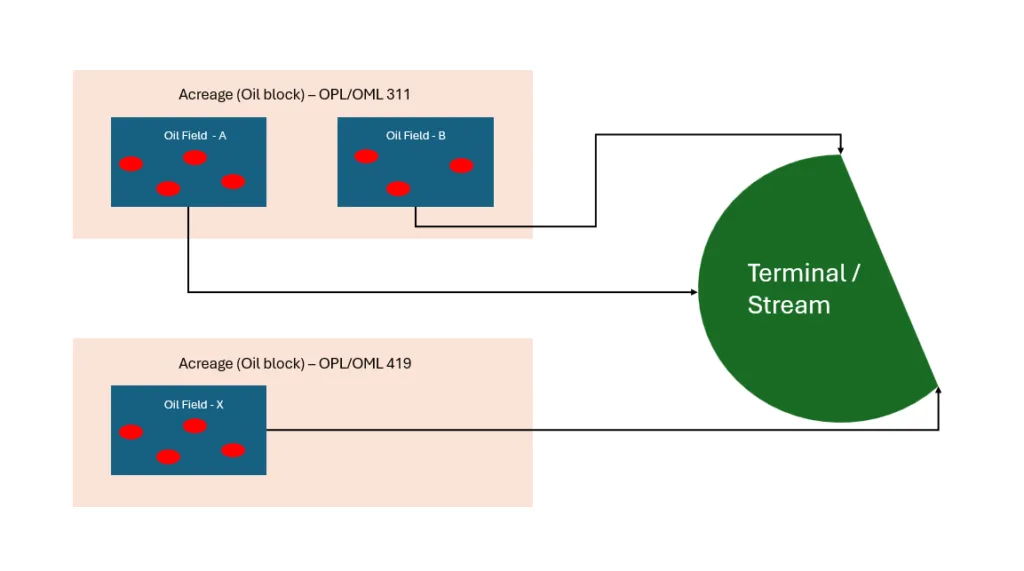
5. Terminal & Stream:
A terminal is the export point where crude oil is stored and loaded onto ships (or pipelines) for sale/export.
A stream refers to a type or blend of crude oil that flows from one or more fields to a terminal. Each stream usually represents a blend of crude oil with similar characteristics such as API gravity (light or heavy crude), sulfur content (sweet or sour), color, etc. Even if different fields are far apart, if their oil has similar chemistry, operators can mix them into the same stream. Some terminals handle multiple streams if workers store the crudes separately.
What are the licenses needed?
6. OML & OPL: These are licenses that the government gives to oil companies, authorizing them to carry out activities of oil & gas.
Oil Prospecting License (OPL): This means a license to look for oil at a particular oil block.
Oil Mining Lease (OML): This means you found oil; we are now leasing that place to you so that you can produce it.
Under the new PIA:
OPL is now PPL (Petroleum prospecting License)
OML is now PML (Petroleum Mining Lease)
If you have been given an oil block with a license number OPL 978, it means go and look for oil within that delineated area carved out by the NUPRC. After which, if you find oil in large quantities and want to begin producing and selling, then we (the government) can convert your OPL (license) 978 to something like OML 897, authorizing you to start working—i.e., producing and selling.
In summary:
An oil block (acreage) is an area licensed to search for oil. It contains many fields. It’s granted by the government in the form of OPL/OML. Fields are part of the oil block where oil is found. It contains oil wells. It is discovered during exploration. Wells are holes drilled to bring oil to the surface. It is inside an oil field. It is drilled after finding oil, and these wells are drilled to target reservoirs.
Remember to think of reservoirs as tanks buried underground. And you need to dig or drill to target the reservoirs in order to bring out your treasure (oil and gas) to the surface.
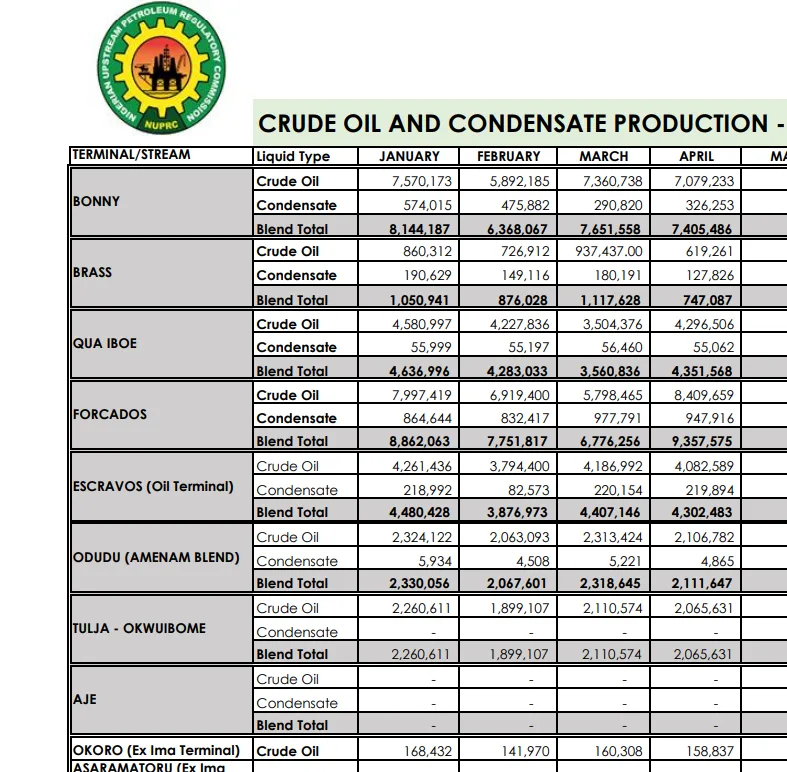
Nigerian Oil and Gas Grid System
The government numbered OPL/OML using a structured grid system and divided Nigeria’s basins into different blocks for exploration and production, creating grids like squares on a chessboard.
Each block in the grid is given a unique number like OPL 245, OML 113, etc. The Exploration and Acreage Management Department in NUPRC handles all issues around oil blocks (acreage), like the naming of oil fields and the naming of oil blocks.
The department gazetted the ‘Acreage Management and Petroleum (Drilling and Production) Regulation, 2024’ on 12th April 2024.
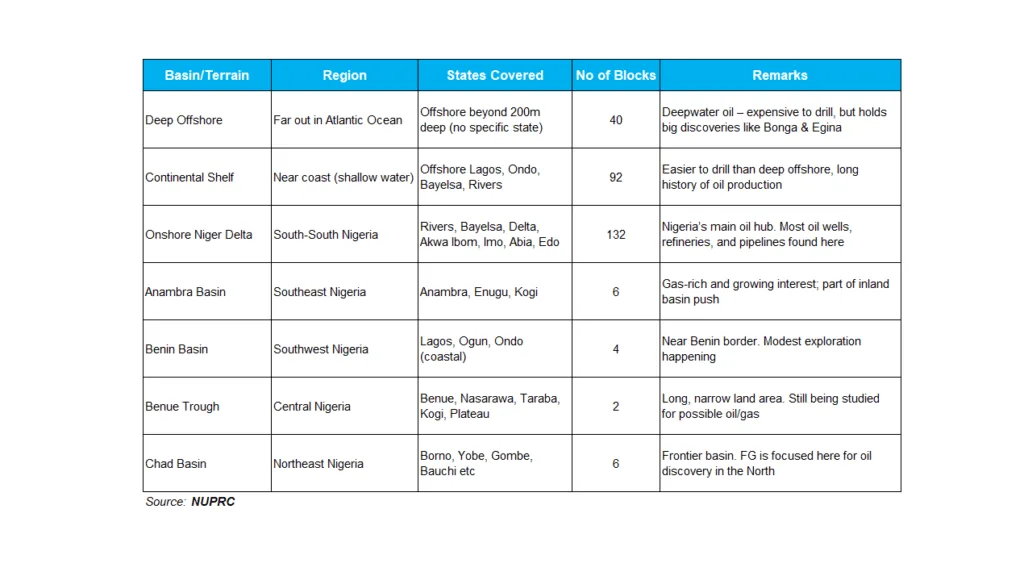
The NUPRC recognizes seven (7) different basins/troughs in the country. The table below summarizes them.
In the Nigerian oil and gas industry, crude oil is more valuable, hence the attention. We also produce gas.
The Nigerian Gas
There are two (2) categories of gas produced:
1. Associated Gas, and
2. Non-associated gas (NAG)
1. Associated gas (AG):
This is the gas that comes out of the ground along with crude oil. The same reservoir mixes it with oil. Workers separate the gas at the surface when they produce oil. Something like palm oil and water mixed in the same bottle. The site uses the associated gas to power equipment.
The process pushes the associated gas back into the underground oil well to maintain pressure and keep the oil flowing. Like forcing air back into a balloon, it pushes the liquid inside and keeps it coming out (this is called gas re-injection).
Workers burn off the associated gas at the well site, usually with a tall flame. It’s like burning leftover food because you don’t have a fridge to store it. They call this gas flaring. The processing platform could also flare the gas via a flare vent after workers strip or separate it from the oil. Companies flare most gas because they lack a pipeline or viable market for it. The storage process is expensive and not viable for some companies.
To deter flaring, companies are paying penalties for gas flared. This also constitutes revenue shareable to the federation. For most oil companies, paying penalties on gas flaring is more profitable to them than investing in equipment to store and process the gas for industrial use.
2. Non-associated gas (NAG):
This natural gas occurs alone, not mixed with any crude oil. It comes from gas-only fields. Such fields contain liquids called condensates. The Anambra basin has more gas potential than the Niger Delta region. NNPC Ltd. and Seplat are currently partnering to develop one of the biggest non-associated gas fields, the Assa North-Ohaji South (ANOH) gas field, located in Imo State.
The gas field is waiting for the completion of the OB3 pipeline to make it a more viable venture.
We all know that gas is important. Industries use natural gas for electricity generation, cooking, and fertilizer production, and manufacturers use it to make other petrochemical products.
So, this is the end of part 1. We will discuss part 2 soon by explaining the different contracts applicable in the Nigerian oil and gas industry, majorly focusing on the PSC and JV contracts.
Credit: Habu Sadeik
Leave a Reply