
There is a pervasive myth in American culture that being good with money requires massive amounts of willpower. We imagine the financially savvy as people who sit at their kitchen tables every Friday night, sifting through receipts, updating complex spreadsheets, and agonizing over every $5 latte.
That might have been true in 2005. In 2026, relying on willpower is a strategy designed to fail.
Willpower is a finite resource. By the time you finish a 50-hour workweek, commute home, and get dinner on the table, your decision-making battery is empty. If your financial plan relies on you making the “right choice” every time you open your wallet, you will eventually slip up.
The true path to wealth in the modern economy isn’t discipline; it’s automation.
The “Lazy Genius” approach is simple: Make the hard decision once (setting up the system) so you never have to make it again. By leveraging the right fintech tools, you can build a system that saves, invests, and pays bills for you while you sleep.
Here are the 5 best apps to build your “Set It and Forget It” financial ecosystem in 2026.
1. Monarch Money
(Best for: Replacing the spreadsheet and seeing the big picture)
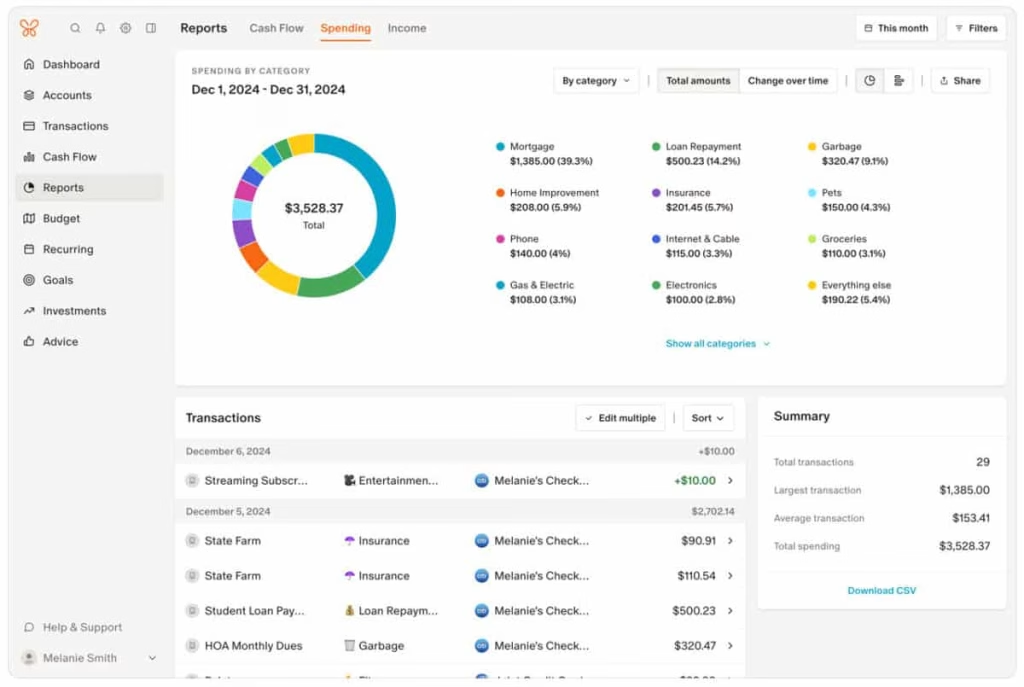
Since the death of Mint a few years ago, the race for the best dashboard has been fierce. In 2026, Monarch Money has emerged as the clear winner for serious wealth builders.
The problem with most banking apps is that they are siloed. Your Chase app doesn’t know about your Fidelity IRA, and your crypto wallet doesn’t talk to your student loans. You are flying blind.
Why it works for automation:
Monarch allows you to build a rules system that is far superior to old-school budgeting. Instead of manually categorizing every transaction, you teach the AI once: every charge from Chevron is “Gas,” or every transfer to Vanguard is “Future Freedom.”
The Setup Strategy:
Don’t use it to restrict your spending. Use it to track your net worth. Set up a weekly notification that simply tells you your total net worth number. This gamifies your finances. When you see that number go up automatically every week, your brain gets a dopamine hit that reinforces good behavior without the shame of a strict budget.
2. Acorns
(Best for: People who think they can’t afford to invest)
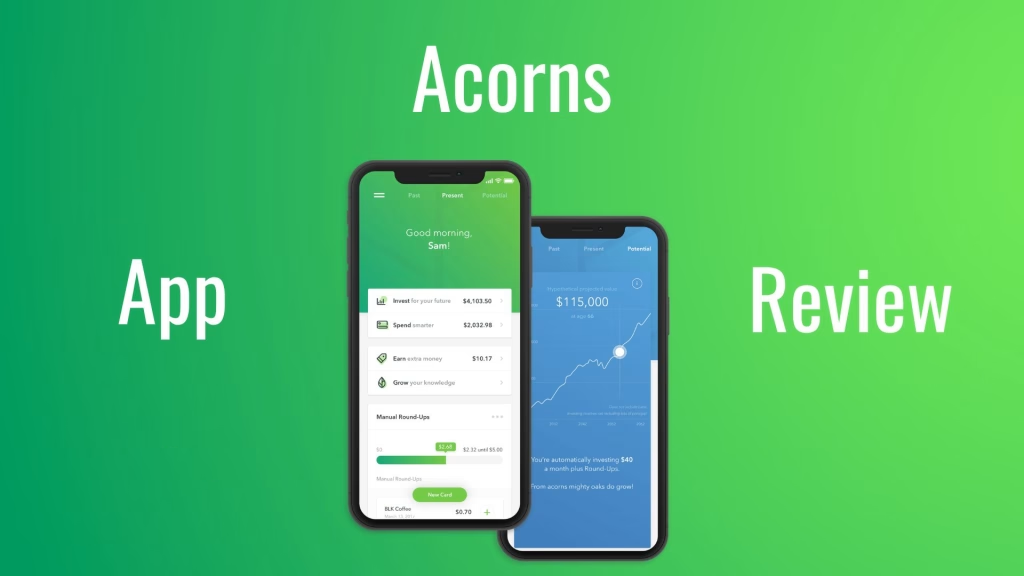
If you are waiting until you have extra money to start investing, you will wait forever. Parkinson’s Law states that your spending will always rise to meet your income. Acorns bypasses your psychology entirely by making investing invisible.
Why it works for automation:
Acorns is famous for Round-Ups. If you buy a coffee for $4.50, the app pulls $5.00 from your bank, sends $4.50 to the coffee shop, and silently drops the $0.50 difference into a diversified portfolio of ETFs (Exchange Traded Funds).
The 2026 Update:
In 2026, the Round-Up feature is just the entry point. The real power move is the Smart Deposit feature. You can set a rule that says, “Every time my paycheck hits, immediately take 5% and move it to my investment account before I even see it.”
By the time you log into your main bank account to pay bills, that money is already gone and growing. You can’t spend what you don’t see. It is the digital equivalent of stuffing cash in a mattress, except this mattress earns compound interest.

3. Wealthfront
(Best for: Storing your Emergency Fund)
Where does your cash sleep at night? If it is sitting in a traditional checking account at a Big Four bank (Chase, Bank of America, Wells Fargo, or Citi), you are losing money every single day due to inflation. Traditional banks often pay a pitiful 0.01% interest.
Wealthfront is the king of high-yield savings account automation.
Why it works for automation:
Wealthfront offers a feature literally called Self-Driving Money. You set a maximum balance for your checking account (say, $3,000 for monthly bills). Any penny that lands in that account above $3,000 is automatically swept instantly into your High-Yield Savings Account (HYSA) or your investment portfolio.
The Strategy:
Stop manually transferring money to savings. Connect your direct deposit to Wealthfront. The software will ensure your bills are paid, and every extra dollar is immediately deployed to capture the current high interest rates of 2026. It removes the temptation to let cash linger in your checking account, where it might get spent on impulse purchases.
4. Rocket Money
(Best for: Cutting costs without effort)
Automation isn’t just about saving; it’s about defense. We live in the era of subscription fatigue. You signed up for a streaming service to watch one show three years ago, and you’ve been paying $15.99 a month ever since. These are zombie subscriptions; they are dead to you, but they keep eating your brain (and wallet).
Why it works for automation:
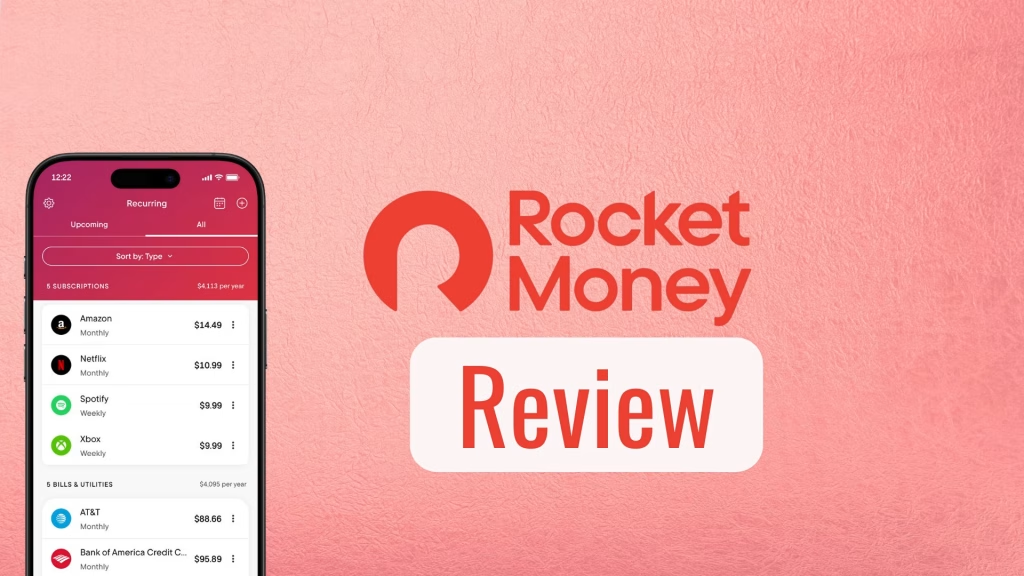
Rocket Money scans your transaction history to identify recurring charges. It presents you with a hit list of subscriptions. With one tap, they can cancel services for you.
The 2026 Update:
The killer feature for 2026 is their Bill Negotiation AI. Rocket Money can contact your internet or cell phone provider on your behalf and negotiate a lower rate. They have the data to know exactly what other customers in your zip code are paying, giving them leverage you don’t have. They do the awkward haggling; you split the savings with them. It is found money.
5. Robinhood Gold
(Best for: Maxing out your IRA)
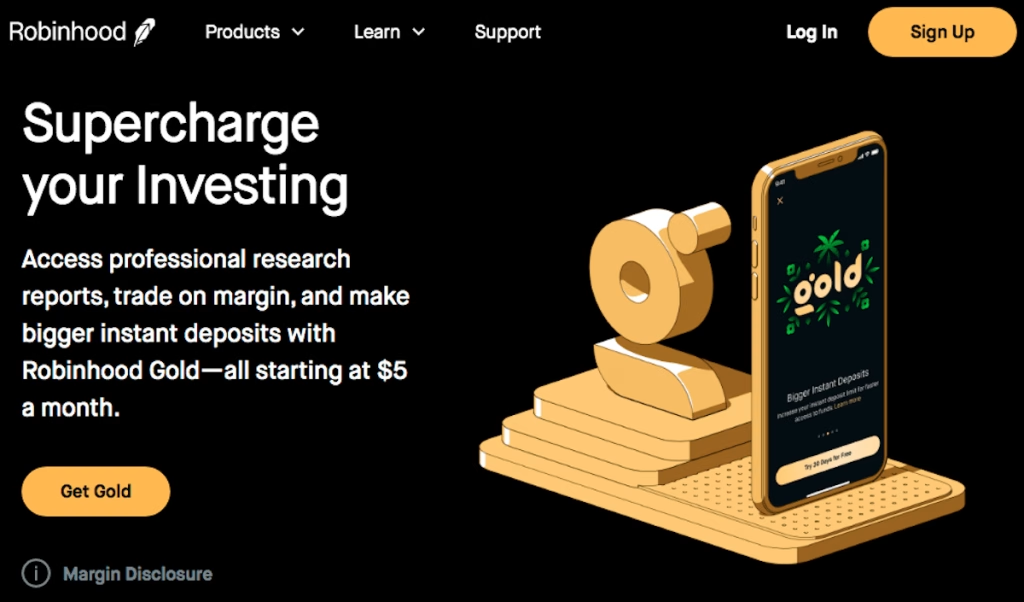
Robinhood started as a gambling app for day traders, but in recent years, it has pivoted to become a powerhouse for long-term retirement planning, specifically with its IRA Match.
Why it works for automation:
The barrier to setting up a Roth IRA is usually friction. It feels complicated. Robinhood removes the friction. But the real automation hook here is the 3% match.
If you set up an automatic contribution to max out your IRA (which has higher contribution limits in 2026), Robinhood effectively pays you to save.
The Strategy:
Set up a recurring deposit on payday for $583 (roughly the amount needed to max a $7,000 annual limit). Select a “Lifecycle Fund” or a broad S&P 500 ETF (like VOO). Turn on “Dividend Reinvestment” (DRIP).
This creates a triple-layer automation cake:
- The money moves automatically.
- The 3% match hits your account automatically.
- The dividends reinvest themselves automatically to buy more shares.
The “Stacked” Ecosystem: How to Link Them
You don’t just want five separate apps; you want a machine. Here is how to stack them for the ultimate automated wealth-building system:
- Income Source: Your paycheck hits your main checking account.
- The Filter: Wealthfront watches that account. It keeps enough for bills and sweeps the rest into high-interest savings.
- The Investor: Robinhood and Acorns pull their monthly “taxes” from that savings bucket to invest for your future.
- The Watchdog: Rocket Money monitors the transactions to ensure no zombie subscriptions sneak in.
- The Dashboard: You check Monarch Money once a week to see your net worth rise, confirming the machine is working.
Conclusion: Return on Energy (ROE)
In finance, we talk about Return on Investment (ROI). But the most important metric for your life is Return on Energy (ROE).
Manually paying bills, transferring savings, and picking stocks has a low return on energy. It is stressful and prone to error. By spending two hours this weekend downloading these best money automation apps of 2026 and configuring your rules, you’re freeing up hundreds of hours of mental bandwidth for the rest of the year.
You are not just automating your money; you are buying back your peace of mind. And that is the best investment you can make.
Disclaimer: This content is for informational purposes only. The author is not a financial advisor. Mention of specific apps does not constitute an official endorsement, and features/fees may change. Always read the fine print.
Leave a Reply