
Debt financing is the process of raising capital through borrowed funds that must be repaid with interest over time.
For entrepreneurs and established companies, debt financing matters because it fuels strategic growth while preserving control.
In this guide, we will explore what debt financing is, how it works, its different types, advantages, disadvantages, and how it compares with equity financing so you can make informed decisions about funding your business.
Key Takeaways
- Debt financing allows businesses to raise funds through borrowing while retaining full ownership and control, making it a powerful tool for sustainable growth.
- Choosing the right type of debt funding depends on a company’s size, cash flow stability, and long-term goals.
- While debt financing offers predictable costs and tax advantages, it also introduces repayment obligations and financial risk if not properly managed.
- Entrepreneurs should use well-structured financial plans and expert guidance to balance debt and equity, ensuring capital decisions support long-term success.
What Is Debt Financing?
Debt financing refers to the practice of raising money for a business by borrowing from external sources and agreeing to repay the borrowed amount, known as the principal, along with interest over a specified period.
The borrower, whether an individual entrepreneur, small business, or large corporation, obtains funds from banks, financial institutions, investors, or through instruments such as bonds, term loans, or lines of credit.
At its core, debt financing gives businesses the flexibility to fund operations, purchase equipment, expand into new markets, or manage cash flow without diluting ownership.
The business retains full control of its equity, but takes on the responsibility of servicing the debt according to agreed terms.
See also: Funding Options for Entrepreneurs and Small Business Owners
Key Components of Debt Financing
To understand how debt financing works, it helps to look at its main components:
| Component | Description | Example |
| Principal | The amount borrowed by the business. | A company borrows $200,000 to buy machinery. |
| Interest | The cost of borrowing, expressed as a percentage of the principal. | 10% annual interest on $200,000 equals $20,000. |
| Tenure | The duration over which the loan must be repaid. | A 5-year loan with quarterly payments. |
| Repayment Schedule | The agreed timeline for paying back the loan. | Monthly, quarterly, or bullet repayment at maturity. |
| Collateral | Assets pledged as security for the loan. | Property, equipment, or accounts receivable. |
These elements together determine the structure and cost of the financing arrangement.
Debt Financing and Business Growth
Many successful companies rely on debt financing to scale operations efficiently.
According to data from the World Bank, over 65% of formal small and medium enterprises (SMEs) worldwide have used some form of external debt financing to support their operations.
This underscores its role as a critical driver of business expansion and economic development.
For entrepreneurs, the decision to use debt financing often comes down to balancing growth ambitions with financial discipline.
When managed responsibly, it strengthens a company’s credit profile, improves liquidity, and enables reinvestment of profits into other value-generating activities.
See also: 25 Free Google Tools for Businesses
Debt Financing vs Borrowing from Personal Funds
While both involve the use of borrowed money, formal debt financing differs significantly from drawing on personal savings or informal loans.
The former offers structured repayment terms, legal protection, and access to larger capital pools. It also helps separate business and personal finances, an essential step toward professionalizing operations and attracting investors.
How Does Debt Financing Work
Debt financing works through a structured borrowing process where a business obtains funds from lenders with a clear repayment plan and cost of borrowing.
The process is guided by the company’s creditworthiness, financial projections, and the intended use of funds.
It gives businesses access to capital for growth, expansion, or cash flow management while keeping ownership intact.
The Process of Debt Financing
Debt financing typically follows five key stages.
| Stage | Description | Key Considerations |
| 1. Assessing Funding Needs | The lender and borrower agree on the interest rate, repayment period, and collateral. | Determine the exact amount required and repayment capacity. |
| 2. Choosing the Right Type of Debt | Selects the financing option that best suits the goal (loan, bond, credit line, or venture debt). | Match the loan type with the business’s financial stability and growth stage. |
| 3. Structuring the Loan Terms | The borrower repays according to the schedule and tracks debt obligations. | Understand all fees, covenants, and the impact on cash flow. |
| 4. Approval and Disbursement | The lender reviews financial statements, credit score, and business plan before approving the loan. | Ensure documentation is complete and meets lender requirements. |
| 5. Repayment and Monitoring | The borrower repays according to schedule and tracks debt obligations. | Maintain healthy cash flow and avoid default. |
Each stage requires careful planning and financial analysis to ensure the business can manage the debt responsibly.
Interest Rates and Repayment Structure
The cost of debt financing is determined by the interest rate, which may be fixed or variable.
Fixed interest remains constant throughout the loan term, offering predictability, while variable interest fluctuates with market rates.
Repayment can take several forms, such as equal instalments, bullet repayment at maturity, or customized schedules aligned with cash flow.
Businesses with steady revenue streams often choose regular instalments, while project-based companies may prefer balloon or bullet structures.
| Repayment Structure | Description | Suitable For |
| Amortized Payments | Equal payments covering both interest and principal over time. | Businesses with predictable income. |
| Bullet Payment | Full repayment at the end of the loan term. | Short-term loans or bridge financing. |
| Balloon Payment | Smaller payments initially, with a large final payment. | Firms expecting future cash inflows. |
Creditworthiness and Collateral
Lenders assess the borrower’s creditworthiness using factors such as credit history, cash flow, and debt-to-equity ratio.
For secured loans, collateral like property, inventory, or receivables may be required. Unsecured debt, on the other hand, depends heavily on credit rating and business reputation.
Maintaining a good repayment record improves a company’s credit score, making future borrowing easier and cheaper.
Debt Financing Example
Imagine a manufacturing company seeking $500,000 to upgrade its production facility. It applies for a five-year term loan at a fixed 8% interest rate. The business pledges its equipment as collateral.
Over the loan term, it repays monthly instalments covering both interest and principal. The facility expansion leads to a 20% revenue increase within two years, enabling the company to meet its loan obligations comfortably while retaining full ownership.
This example illustrates how debt financing, when properly structured, can fuel growth without giving up equity.
Types of Debt Financing
Businesses can access different types of debt financing depending on their size, cash flow, and funding needs.
Each option has distinct repayment structures, costs, and levels of risk. Understanding these helps entrepreneurs choose the right form of financing to match their business goals.
Term Loans
Term loans are the most common type of debt financing. A business borrows a fixed amount and repays it with interest over a set period, usually between one and ten years.
Term loans suit established companies with predictable revenue that need funds for equipment, expansion, or working capital.
| Feature | Description |
| Loan Amount | Typically, medium to large sums depending on credit rating. |
| Repayment | Fixed monthly or quarterly instalments. |
| Best For | Businesses with stable cash flow. |
| Example | A retailer borrows $300,000 for store expansion, repaid over five years at 9% interest. |
Lines of Credit
A business line of credit allows companies to borrow up to a specified limit as needed, repay, and borrow again.
Interest is charged only on the amount drawn. It is ideal for managing short-term cash flow gaps or seasonal expenses.
| Feature | Description |
| Flexibility | Access funds on demand. |
| Cost | Interest applies only to utilized amounts. |
| Tenure | Revolving facility renewable annually. |
| Example | A fashion brand uses a $100,000 credit line to fund seasonal inventory purchases. |
Equipment Financing
Equipment financing helps businesses purchase machinery, vehicles, or technology. The asset itself serves as collateral, making approval easier for SMEs with limited credit history.
| Feature | Description |
| Purpose | Purchase of equipment or machinery. |
| Security | Equipment serves as collateral. |
| Advantage | Preserves working capital. |
| Example | A bakery buys new ovens worth $80,000 and repays over three years. |
Asset-Based Lending (ABL)
Asset-based lending allows companies to borrow against existing assets such as inventory, receivables, or property.
Lenders typically advance a percentage of the asset’s value, often 70% to 90%. It’s suited for businesses with significant assets but limited cash flow.
| Feature | Description |
| Collateral | Assets like inventory or accounts receivable. |
| Loan-to-Value Ratio | 70%–90% of asset value. |
| Best For | Businesses needing liquidity to manage operations. |
Trade Credit
Trade credit is an informal but essential form of short-term debt financing where suppliers allow businesses to buy goods or services and pay later, usually within 30 to 90 days.
It boosts cash flow without immediate cash outlay.
| Feature | Description |
| Source | Supplier or vendor. |
| Duration | 30–90 days. |
| Cost | Usually interest-free if paid on time. |
| Example | A supermarket chain pays suppliers 60 days after delivery. |
Bonds and Notes
Large corporations and governments often raise long-term capital through bonds.
Investors lend money by purchasing bonds, and issuers pay periodic interest (coupons) until maturity. Bonds can be secured or unsecured depending on the issuer’s credibility.
| Feature | Description |
| Tenure | Medium to long term (5–20 years). |
| Interest | Fixed or variable coupon. |
| Best For | Corporations with strong credit ratings. |
| Example | A global firm issues $10 million in bonds to finance a new plant. |
Venture Debt
Venture debt is designed for startups that have raised equity capital but want to extend their cash runway without giving up more ownership.
It’s usually structured as a medium-term loan with an interest rate plus a small equity warrant.
| Feature | Description |
| Borrower | Growth-stage startups. |
| Security | Often unsecured but backed by investors. |
| Advantage | Non-dilutive capital to fund growth. |
| Example | A tech startup raises $2 million in venture debt to fund product development. |
Mezzanine Financing
Mezzanine financing combines features of debt and equity. It is subordinated debt, meaning it ranks below senior loans but above equity in repayment priority.
It often carries higher interest and may include equity warrants.
| Feature | Description |
| Risk Level | High, due to subordinated position. |
| Reward | Higher returns for lenders. |
| Best For | Businesses preparing for expansion or acquisitions. |
| Example | A manufacturing company uses mezzanine financing to fund a merger. |
Comparing the Types of Debt Financing
| Type | Repayment Period | Collateral Required | Interest Cost | Suitable For |
| Term Loan | 1–10 years | Usually required | Moderate | Established businesses |
| Line of Credit | Short term | Sometimes | Variable | Seasonal businesses |
| Equipment Finance | Medium term | Yes | Moderate | Asset-heavy businesses |
| ABL | Short to medium | Yes | Varies | Companies with inventory/receivables |
| Trade Credit | Short term | No | Low | Retailers and distributors |
| Bonds | Long term | Optional | Low to moderate | Large corporations |
| Venture Debt | Medium term | Sometimes | Moderate to high | Startups |
| Mezzanine | Long term | Usually unsecured | High | Growth-stage businesses |
Advantages of Debt Financing
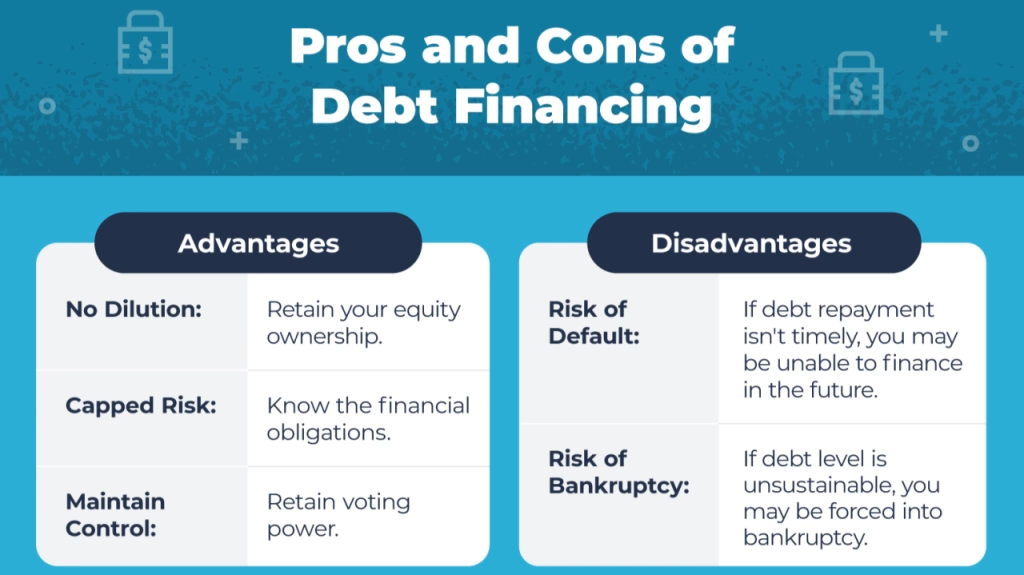
Debt financing offers several benefits that make it an attractive option for businesses seeking growth without losing ownership.
When used strategically, it can strengthen financial stability, build credit history, and optimize tax efficiency.
Understanding these advantages helps entrepreneurs make smarter funding decisions and leverage debt as a growth tool.
Retains Full Ownership and Control
Unlike equity financing, which requires giving investors a share of the business, debt financing allows entrepreneurs to maintain complete ownership.
Lenders have no claim over decision-making or profit distribution once repayments are complete. This means the founders retain control over strategy, vision, and profit allocation.
Predictable Repayment and Cost of Capital
Debt financing offers predictable repayment schedules and fixed interest rates, allowing businesses to plan their cash flow effectively.
This predictability helps in budgeting and long-term financial forecasting. Fixed interest costs make it easier to measure the return on investment from borrowed funds.
| Feature | Description | Benefit |
| Fixed Interest | Interest remains constant throughout the loan term. | Simplifies financial planning. |
| Regular Repayments | Structured payments over time. | Reduces uncertainty. |
| Budgeting Ease | Businesses can forecast accurately. | Ensures financial discipline. |
Tax-Deductible Interest
In most countries, the interest paid on business loans is tax-deductible. This means borrowing through debt financing can effectively reduce a company’s taxable income, improving net profitability.
For instance, if a business earns $500,000 annually and pays $50,000 in interest, its taxable income decreases to $450,000.
According to the Organization for Economic Co-operation and Development (OECD), businesses that use debt strategically often improve their post-tax cash flow by 10 to 15 percent compared to firms relying solely on equity capital.
Builds Credit History and Lender Confidence
Consistently meeting debt obligations enhances a business’s creditworthiness. A strong credit history enables future borrowing at more favorable terms and interest rates.
It also signals reliability to potential partners, suppliers, and investors.
Enhances Return on Equity (ROE)
By financing projects with borrowed funds rather than issuing new equity, businesses can increase their return on equity. Debt magnifies returns when revenues exceed the cost of borrowing.
For example, if a business earns 15% on an investment financed by debt costing 8% interest, the difference contributes directly to profit growth and shareholder value.
Flexibility in Financing Options
Debt financing comes in multiple forms: short-term lines of credit, long-term loans, bonds, or venture debt, allowing businesses to tailor borrowing to specific needs.
This flexibility supports different stages of growth, from launching a startup to funding global expansion.
| Financing Need | Ideal Debt Type | Key Advantage |
| Short-term working capital | Line of Credit | Quick access to cash |
| Asset acquisition | Equipment Loan | Asset-backed and affordable |
| Business expansion | Term Loan | Predictable, structured funding |
| Growth after equity round | Venture Debt | Non-dilutive capital |
Improves Financial Discipline
Debt financing encourages businesses to operate efficiently. Regular repayments create accountability and force management to monitor cash flow closely.
This discipline often leads to better financial management and operational efficiency.
Facilitates Scalable Growth
Access to debt allows companies to scale operations, enter new markets, and invest in innovation without giving away equity.
According to the International Finance Corporation (IFC), SMEs with access to structured debt financing grow revenues 20 to 30 percent faster than those relying solely on internal funds.
Disadvantages of Debt Financing
While debt financing provides access to capital without giving up ownership, it also introduces financial responsibilities that can strain a business if not carefully managed.
Understanding these disadvantages helps entrepreneurs evaluate risks and design borrowing strategies that support long-term sustainability.
Regular Repayments Create Cash Flow Pressure
The most immediate drawback of debt financing is the obligation to make fixed repayments regardless of business performance.
During economic downturns or slow sales cycles, meeting repayment schedules can strain liquidity and hinder operations. For startups or seasonal businesses, this can limit flexibility and lead to potential defaults.
| Risk Factor | Description | Potential Impact |
| Fixed Payment Obligation | Repayments continue even when revenue drops. | Cash flow strain or default. |
| Irregular Income | Unsteady sales make repayment harder. | Operational stress. |
| Delayed Receivables | Slow customer payments disrupt debt servicing. | Increased borrowing for working capital. |
Increased Financial Risk and Leverage
Debt financing increases a company’s leverage ratio, meaning a greater portion of the business is funded by borrowed money.
While leverage can enhance returns when profits rise, it magnifies losses during downturns. High leverage also makes a company vulnerable to interest rate hikes and limits its ability to secure future loans.
| Ratio | Description | Ideal Benchmark |
| Debt-to-Equity (D/E) | Measures the proportion of debt-to-equity capital. | Below 2:1 for most industries. |
| Debt Service Coverage Ratio (DSCR) | Indicates a firm’s ability to meet debt obligations from operating income. | Above 1.25x preferred by lenders. |
Collateral Requirements Limit Flexibility
Many forms of debt financing, especially term loans and asset-based lending, require collateral such as property, inventory, or equipment.
This ties up valuable assets and can restrict a company’s ability to use them for other financing needs. In the event of default, lenders can seize pledged assets, causing long-term damage to the business.
Covenants and Restrictions
Debt agreements often include covenants, rules set by lenders to protect their interests. These may limit how businesses operate, spend, or take on additional debt.
Breaching a covenant, even accidentally, can trigger penalties, loan recalls, or higher interest charges.
Common covenant examples include:
| Covenant Type | Description | Example |
| Financial Covenant | Requires the business to maintain specific ratios. | Maintain DSCR above 1.25x. |
| Negative Covenant | Restricts certain actions. | Cannot take on new debt without consent. |
| Reporting Covenant | Obligates regular financial disclosures. | Submit quarterly financial statements. |
Interest and Hidden Costs Add Up
Although interest is tax-deductible, it remains a cost that affects profitability. Additionally, businesses may face hidden costs such as arrangement fees, legal fees, and early repayment penalties.
Over time, these expenses can make borrowing more expensive than anticipated.
| Cost Element | Description | Impact on Borrower |
| Interest Rate | Base cost of borrowing. | Reduces profit margin. |
| Processing Fees | Charged by lenders for loan setup. | Adds upfront costs. |
| Prepayment Penalties | Charged for early repayment. | Discourages early clearance of debt. |
Impact on Credit Score
Late or missed repayments negatively affect a company’s credit rating, making it harder and costlier to borrow in the future.
A lower credit score can also deter investors and suppliers, reducing business credibility.
Vulnerability to Economic and Interest Rate Fluctuations
Businesses with variable-rate loans face interest rate risk. When market rates rise, repayment obligations increase, reducing cash flow and profitability.
Economic downturns can further reduce demand, amplifying repayment challenges.
According to the Bank for International Settlements (BIS), businesses exposed to variable interest loans experience a 20% higher likelihood of financial distress during rate hikes compared to those with fixed-rate loans.
Possible Strain on Growth and Innovation
Focusing on debt repayment can divert funds from innovation, marketing, or hiring. For growing businesses, this limitation can slow expansion and reduce competitiveness.
Entrepreneurs relying heavily on debt may also miss opportunities that require quick reinvestment of profits.
Debt Financing vs Equity Financing
Choosing between debt financing and equity financing is one of the most important financial decisions an entrepreneur will make.
Both funding options can support business growth, but they differ in ownership structure, cost, risk, and long-term implications.
Understanding these differences helps entrepreneurs identify which financing path aligns best with their goals and cash flow realities.
Definition and Core Differences
Debt financing involves borrowing money that must be repaid with interest over time. In contrast, equity financing means raising capital by selling ownership stakes in the company to investors.
Debt financing keeps ownership intact but creates fixed repayment obligations. Equity financing provides capital without repayment but dilutes ownership and control.
| Factor | Debt Financing | Equity Financing |
| Ownership | Business retains full ownership. | Ownership shared with investors. |
| Repayment | Regular repayments with interest. | No repayment; investors earn through profit or exit. |
| Cost | Lower long-term cost if managed well. | Higher cost due to loss of equity. |
| Control | Founder retains control. | Investors influence business decisions. |
| Risk | Financial risk if cash flow weakens. | Shared risk among shareholders. |
| Tax Benefit | Interest is tax-deductible. | Dividends are not tax-deductible. |
When to Choose Debt Financing
Debt financing works best when a business has steady cash flow and predictable income to service loan obligations.
It is suitable for companies that want to expand operations, invest in assets, or manage working capital without diluting ownership.
Examples of when debt financing is ideal include:
- Established businesses with consistent revenue streams.
- Companies seeking to fund equipment, property, or short-term operations.
- Firms that can leverage tax benefits from interest payments.
When to Choose Equity Financing
Equity financing is more suitable for startups or high-growth companies that lack collateral or consistent revenue.
It allows businesses to access large sums of money without immediate repayment pressure. However, it requires giving up a portion of ownership and often involves investor oversight.
Examples of when equity financing is ideal include:
- Early-stage startups developing new products.
- Businesses in industries with long payback periods.
- Companies seeking strategic investors with expertise or networks.
Cost Comparison Between Debt and Equity
While debt financing appears riskier because of repayment obligations, it is often cheaper in the long run.
Equity financing may not require repayments, but the cost of giving up ownership and future profits can be substantial.
| Scenario | Debt Financing | Equity Financing |
| Business borrows $500,000 at 8% interest for 5 years | Total cost of interest ≈ $100,000 | Total cost of giving 20% ownership could equal millions if business scales. |
| Ownership impact | 0% ownership lost | 20%–40% equity dilution |
| Long-term control | Maintained | Shared with investors |
According to the Harvard Business Review, businesses that balance moderate levels of debt with retained earnings achieve an average of 30% higher returns on equity compared to those relying solely on equity financing.
Risk Profile and Leverage Effect
Debt financing magnifies both gains and losses. If a business performs well, the return on borrowed funds exceeds the cost of interest, increasing profitability.
However, in periods of weak performance, debt repayment can strain finances. Equity financing spreads the risk among investors but reduces the founder’s share of future profits.
Strategic Combination: Blended Financing
Many successful businesses combine debt and equity financing to balance risk and flexibility. For example, a company might raise equity to fund product development and use debt to scale production once cash flow stabilizes.
This blended approach allows businesses to optimize their capital structure and minimize the weighted average cost of capital (WACC).
| Financing Mix | Benefit | Common Users |
| 70% Debt + 30% Equity | Lower cost of capital, tax benefits, control retained. | Established SMEs and mid-sized firms. |
| 50% Debt + 50% Equity | Balanced risk and flexibility. | Growth-stage startups. |
| 30% Debt + 70% Equity | Low financial risk, high investor oversight. | Early-stage startups. |
Which Is Better for Your Business?
There is no universal answer. The right choice depends on your company’s cash flow, growth stage, and risk tolerance.
Debt financing favors businesses with stable revenues, while equity financing supports innovation-driven ventures still building traction.
Conclusion
Debt financing remains one of the most reliable ways for businesses to access capital, maintain ownership, and fund sustainable growth.
When used wisely, it strengthens cash flow, builds credit history, and enhances profitability through tax advantages and leverage.
However, it also requires discipline and careful planning. Poorly structured debt can burden a company with repayment stress, reduce flexibility, and limit innovation.
Leave a Reply