
Let’s discuss another interesting part of the Nigerian oil and gas industry, specifically on contracting issues and peculiarities. For a better understanding, read part 1 of the series here.
In line with section 85 of the Petroleum Industry Act (PIA), let’s try to understand the applicable Nigerian oil and gas contracts in the sector.
1. Joint Venture Contract (JV)
2. Production Sharing Contract (PSC)
3. Sole risk, and
4. Marginal Field (though, this has been abolished)
This is part 2 article, if you’re reading this for the first time, here is the part 1 where we discuss oil block, oil field, oil wells and licensing (OPL/PPL, OML/PML).
1. Joint Venture Contract (JV)
A Joint Venture (JV) in Nigerian oil and gas industry is a type of business partnership where the Nigerian government (through the NNPC Limited) works together with international oil companies (IOCs) like Shell, Seplat, ExxonMobil, etc., to explore and produce oil. Think of it like two or more people bringing their money, skills, and resources to run a business (in this case, finding and selling oil) and they share both the costs and the profits.
Who are the partners?
NNPC Ltd – representing the Nigerian government (FG, States & LG)
Oil Companies – e.g., Renaissance, Total, Chevron, Seplat, First E&P, Newcross, Belema etc.
They both invest money to fund oil exploration, drilling, production, etc. JV Contracts is governed by a legal document called “Joint Operating Agreement” or “JOA”.
It covers everything from profit sharing, operating complexities, cost contributions, dispute resolution mechanisms, etc.
The JOA is what outlines the ownership structure between NNPC Ltd and other oil companies and how much is required for exploration and production of oil from the ground. So, the first thing you determine in JV contract is the ownership percentage, (e.g., 60% NNPC, 40% Total).
This ownership percentage is what forms the basis of how you contribute capital, cost and share profit between the JV Partners. A JV does not refer to only 2 parties, it is 2 or more.
You can have 3 or 4, or even 5 parties on a joint venture, e.g., NNPC/Renaissance/Total Energies/AENR – JV.
Key features of JV Contract
1. Cost Sharing: Both NNPC and the oil company(s) share the cost of drilling and producing oil, based on how much stake each one owns.The initial amount the JV partners contribute is called capital contributions while any subsequent amount you bring in terms of operations is called cash call.
2. Profit Sharing: After selling the oil, the money is shared based on the ownership split (e.g., 60% NNPC, 40% Shell). For instance, a profit after tax of $500m would be shared 60% to NNPC while 40% to Total Energies or Chevron in line with the JOA.
3. Operatorship: Operator means the company in the JV that runs day-to-day technical activities of the work. E.g., you may have NNPC/Total/Shell Joint venture contract on a particular oil block. One among the 3 companies above should be selected to be the operator of that oil block. Usually, the Oil Companies are the operator, in the example above, Total or Shell maybe the operator.
As an operator:
- You get to run the day-to-day activities of exploration, drilling, production etc.
- You decide how the work is done (within JV agreement rules).
- You can use your own technical systems, engineering methods, and personnel. This makes operations more efficient if the company has strong experience. (e.g., IOC).
In line with the JV agreement, the operator will prepare the budget and work plan and submit to other JV partners for their approval. The budget must be jointly approved by all the JV Partners.
To whom much is given, much is expected. The operator would be responsible for poor production results, accidents, delays etc. The JV partners may also integrate their staff in the oil block, if need be, in line with operational guidelines. That is why sometimes you can find NNPC staff working with Chevron in the oil field.
Now, after the budget is jointly approved, the operator requires cash backing on the budget every month to ensure that operation or production is going smoothly. The process of getting these cash is what we refer to as “cash call”. Cash calls are requests for money made by the operator of a JV to the non-operating partners. Example, in NNPC/Chevron JV. If Chevron is the operator, they will send a cash call request to NNPC Ltd. It is like saying bring money let us finance our operation for this upcoming month.
Illustration:
NNPC/Chevron JV
Ownership share: NNPC 60% Shell 40%
Chevron, as an operator, prepares a work program and budget for the upcoming month of $250m. They send a cash call request to NNPC, requesting them to pay their share which is $250m*60% = $150m while the balance of 40% ($100m) would be provided by the operator. NNPC transfers the money to the JV Account and the operator uses it to fund operations.
The problem arises when NNPC is unable to provide its own cash call obligation ($150m), which may lead to delay in activities, production losses, operator’s frustration and the likes. There are also cases where the Operator is unable to provide its cash call obligations. This is why you keep hearing in the news that NNPC is owing cash calls of more than $6b to oil companies, but I think they settled everything in the past 2 years or so. I don’t know for now.
Since transitioning to a Limited Liability Company, NNPC Ltd has been prompt and up-to-date as bureaucratic processes of the past have been eliminated. Think of a typical bureaucracy in the Ministries or Government agencies. Speed, dynamism and operational excellence are key to the oil and gas business. So, because of NNPC failure to meets its cash call, the government introduced a solution called “modified carry agreement” (MCA).
Modified Carry Agreement
In MCA, the oil company who is a JV partner in the venture pays both its own and NNPC’s share, and gets paid back later from oil revenues, plus a small return. NNPC also carried First E&P in the past after Schlumberger pulled out from being a technical partner to First E&P.
Like the above illustration, since NNPC fail to pay its $150m share, Chevron, as an operator, would pay the whole $250m and recover it through the revenue from the venture activities plus a small return (to compensate for time value of money). To avoid repeating the JV cash call problem, the PIA section 65 introduced the Incorporated Joint Venture Companies (IJVCs) model, making it easier for JV partners to raise finance and fund operations.
It’s like the NLNG Model. Create a company and run it as a venture between the partners. You can raise capital from the secondary market in the form of debt to finance the venture in case of funding issues. It eliminates the issue of cash calls entirely. JV Contract is mostly with oil field that are operating onshore, shallow offshore and swamp areas.
2. Production Sharing Contract (PSC)
A Production Sharing Contract (PSC) is mostly associated with deep offshore oil field.
Onshore – oil producing on land.
Shallow offshore – inside water that is not more than 200 meters.
Deep Offshore – Inside water that is more than 200 meters depth.
Swamp – land that is permanently or seasonally wet, often with standing water.
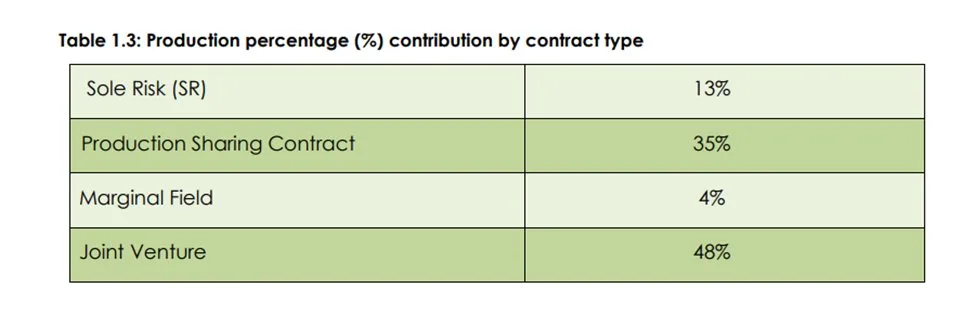
JV Contract constitute the higher percentage of Nigerian oil and Gas production as a country because of the high number of onshore oil fields for which majority of them now is under the new Renaissance Africa Energy Company (RAEC ltd) after acquiring those oil fields from Shell (SPDC).
3. Sole Risk Contract
A Sole Risk Contract is a type of oil and gas agreement where only one company (the investor) takes on all the financial risk and operates alone, without the government (NNPC) sharing the cost or risk of failure.
It is an agreement where you pay for everything. If you succeed, you earn; if you fail, you lose alone. Sole risk contracts were introduced in Nigeria mainly in the 1970s and 1980s when NNPC couldn’t or didn’t want to develop some fields, especially marginal or abandoned fields, or Private companies wanted a chance to develop fields on their own, without waiting for JV partnerships.
In sole risk contract, the company owns the oil temporarily, but the resource still belongs to Nigeria. The license type in sole risk is usually awarded through farm-out, marginal field programs, or bidding rounds.
Farm-out can best be described as:
It is like those people who have oil blocks but do not have the technical or financial capacity to operates them, hence they give it out to those with the technical capacity to do so in exchange for an agreed amount. In sole risk, like any other contract, the investor would pay its fair share of royalties and all relevant taxes applicable in the petroleum industry. Sole risk contract is somehow similar to marginal field.
4. Marginal field
A marginal field is an oil or gas field that was discovered by a major oil company (like Shell or Chevron) but was not developed because it was:
- Too small for their portfolio,
- Too risky or expensive at the time,
- Or not aligned with their priorities.
The government will then give these fields to smaller Nigerian companies to boost local participation and increase oil production.
A Marginal Field Contract gives an indigenous local company the right to operate and produce from an unused or abandoned field usually through a farm-out or licensing bid round. It is often a form of Sole Risk, meaning: The marginal field operator bears 100% of the cost, but also keeps the profit (after paying government royalties and taxes). Example: Let’s say Chevron discovered a small oil field in 1990 but didn’t develop it.
In 2003, the government awards it as a marginal field to ABC Oil Ltd (a Nigerian company). ABC Oil ltd:
- Pays for all costs (e.g., $10 million to develop),
- Produces oil worth $40 million,
- Pays royalty and tax to the government,
- Keeps the rest as profit.
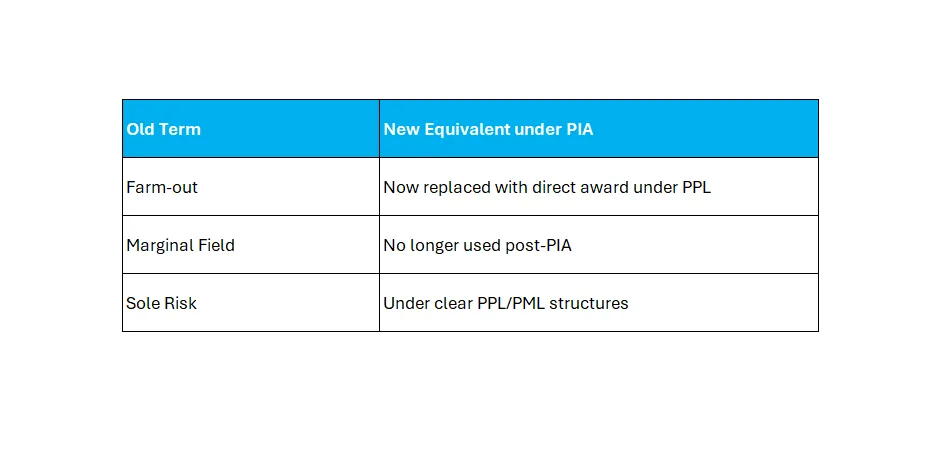
One of the advantages of marginal field is that it is given mainly to Nigerians, it boosts production capacity by small margin and improve our local technical and financial capacity.
Companies like waltersmith, Energia, Oriental Energy are all marginal field operators.
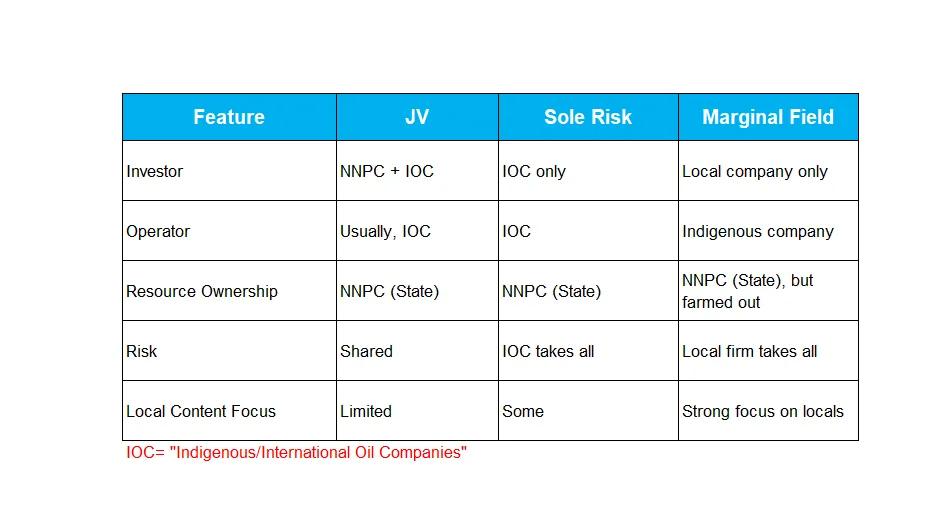
Now, all information relating to what I explain above with respect to marginal field is before the new PIA. PIA made some changes with regards to marginal field.
After PIA 2021, what changed?
1. Marginal Fields Concept Abolished for the Future: PIA abolishes the future use of the term “marginal fields.” Section 94(9) of PIA: No new marginal field shall be declared under this Act. Going forward, all oil fields are commercial fields, awarded under the new Petroleum Prospecting License (PPL) or Petroleum Mining Lease (PML) system.
2. Existing Marginal Fields to Be Converted: PIA mandates that all existing marginal field operators must convert their contracts to new PIA-compliant licenses within a time frame. Conversion is optional, but if you don’t convert, you forfeit renewal rights at expiration. Converting brings clarity, tenure security, and tax reform benefits.
3. Licensing Framework Changed under PIA: So, instead of marginal field farm-out, companies now apply for a PPL, even if it’s a small discovery.
In summary, all the marginal field that is around and reported currently would be converted into PPL/OML as their current license or lease expire. The next form of contract in the industry is Production Sharing Contract (PSC)
Credit: Habu Sadeik
Leave a Reply