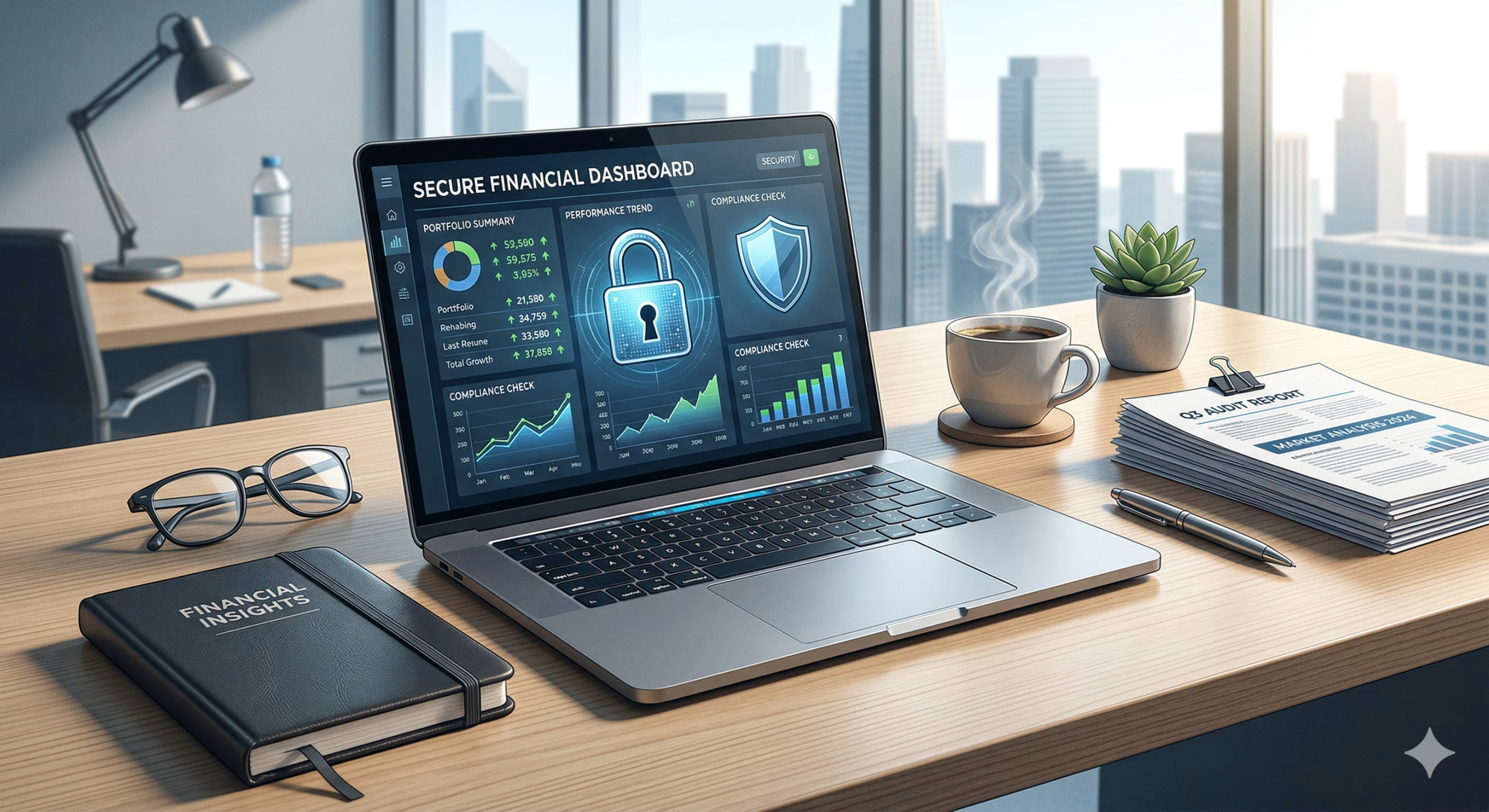
Setting up effective payment controls is not about adding bureaucracy but about creating clear, practical rules that protect cash while allowing the business to operate smoothly.
The strongest payment control frameworks are simple, well-documented, and consistently applied. They evolve as the business grows, but the foundation remains the same: clarity, accountability, and visibility.
See also: Top 10 Accounting Software for Small and Medium Businesses
Assess your payment risks first
Before designing controls, businesses must understand where they are most exposed.
This includes identifying who handles payments, how requests are approved, which channels are used, and where mistakes or fraud could occur.
A clear risk assessment ensures controls are built around real weaknesses, not assumptions.
Define clear payment policies
Payment controls work best when everyone knows the rules.
A written payment policy should explain what types of payments are allowed, who can approve them, required documentation, and escalation procedures.
Clear policies remove ambiguity and reduce pressure-driven or emotional payment decisions.
Separate responsibilities wherever possible
No single person should control payment requests, approvals, and execution.
Even in small businesses, splitting these roles, however lightly, creates accountability.
Where full separation is not possible, compensating controls such as senior oversight or periodic reviews should be introduced.
Set approval limits and workflows
Approval thresholds ensure that higher-value payments receive stronger oversight.
Defining who approves what, and under which conditions, brings consistency to decision-making and reduces risk.
Well-designed workflows prevent unnecessary delays while still enforcing discipline.
Require proper documentation for every payment
Every payment should be supported by clear evidence, such as invoices, contracts, or purchase orders.
Mandatory documentation ensures payments are legitimate and makes future reviews or audits straightforward. Over time, this practice also improves financial reporting accuracy.
Control access to payment systems
Access to banking platforms and payment tools should be limited strictly by role.
Employees should only have the permissions they need to do their jobs, nothing more.
Regular access reviews help prevent misuse and reduce damage if accounts are compromised.
Use technology to enforce consistency
Manual controls rely heavily on memory and goodwill. Payment control systems and software embed rules directly into workflows, ensuring approvals, limits, and documentation are enforced automatically.
Technology reduces human error and allows controls to scale with the business.
Reconcile and review payments regularly
Regular reconciliation ensures recorded payments match what left the bank.
Management reviews help spot patterns, exceptions, and control gaps early.
This habit strengthens trust in financial data and prevents small issues from becoming major losses.
Train staff and reinforce accountability
Even the best controls fail if people do not understand them. Staff should be trained on payment policies, approval rules, and their responsibilities.
Reinforcing accountability builds a culture where financial discipline is respected, not resisted.
Review and improve controls continuously
Payment controls should not be static. As the business grows, adds new payment channels, or enters new markets, controls must be reviewed and updated.
Continuous improvement ensures the system remains effective, relevant, and aligned with business realities.
Key Challenges Businesses Face When Implementing Payment Controls
Implementing payment controls is rarely a technical problem alone, it is often a people, process, and mindset challenge.
Businesses struggle not because controls are unnecessary, but because they are poorly introduced, inconsistently applied, or misaligned with how the business actually operates.
The key is recognising these challenges early and addressing them with deliberate, practical solutions.
| Challenge | How It Shows Up in Practice | Practical Solution |
| Resistance from staff | Employees see payment controls as bureaucracy or a lack of trust. | Communicate why controls exist, involve teams early, and show how controls protect everyone, not just the business. |
| Fear of slowing down operations | Managers bypass approvals to “move fast.” | Design tiered approval limits so routine payments move quickly while high-risk payments receive deeper review. |
| Limited resources | Small teams struggle to separate duties properly. | Use compensating controls such as senior oversight, periodic reviews, or automated workflows to reduce dependency on headcount. |
| Overreliance on trust | Long-serving staff are given unrestricted payment access. | Replace trust-only models with role-based access and audit trails that protect both the business and employees. |
| Manual and fragmented processes | Payments are scattered across emails, spreadsheets, and bank portals. | Centralise payment processes using standard templates or payment control software to improve visibility and consistency. |
| Lack of clear policies | Staff are unsure who can approve what or which documents are required. | Document simple, written payment policies and make them easily accessible to all relevant staff. |
| Cost concerns | Businesses delay investing in control systems to save money. | Start with basic controls first, then scale gradually. Controls do not need to be expensive to be effective. |
| Scaling issues | Controls that worked for 10 payments fail at 200 payments. | Review and redesign controls at key growth stages, not after problems appear. |
| Poor change management | New controls are introduced without training or explanation. | Pair new controls with training, clear communication, and transition periods to encourage adoption. |
When businesses treat payment controls as a living system rather than a one-time setup, these challenges become manageable. The goal is not perfection, but consistent, practical control that grows with the business.
See also: LLC vs. Sole Proprietorship: Which Is Right for You in 2026?
How Entrepreneurs Can Strengthen Payment Controls Immediately
Strengthening payment controls does not always require complex systems or large budgets.
Entrepreneurs can make meaningful improvements quickly by tightening everyday practices, clarifying responsibilities, and introducing simple checks that reduce risk.
Small changes, applied consistently, can dramatically improve financial discipline and protect cash flow.
| Immediate Action | What to Do Right Now | Impact on the Business |
| Document basic payment rules | Write down who can request, approve, and execute payments, and share it with the team. | Removes confusion and prevents ad-hoc payment decisions. |
| Introduce approval limits | Set clear thresholds for approvals based on payment size. | Ensures higher-value payments receive proper scrutiny. |
| Split payment responsibilities | Separate request, approval, and payment execution roles—even if lightly. | Reduces fraud risk and increases accountability. |
| Require evidence for every payment | Make invoices or contracts mandatory before approval. | Stops unsupported and impulsive payments. |
| Restrict access to bank platforms | Review who has payment access and removes unnecessary permissions. | Limits exposure to internal misuse or account compromise. |
| Use dual authorisation where possible | Activate maker–checker controls on bank and payment platforms. | Adds a critical safety layer at the point of payment. |
| Reconcile payments weekly | Match bank statements with internal records regularly. | Quickly catches errors and unauthorised transactions. |
| Review vendor bank details | Verify and lock approved supplier details. | Prevents payment diversion and account change fraud. |
| Train staff on payment discipline | Explain why controls exist and how to follow them. | Builds cooperation instead of resistance. |
| Plan for automation early | Identify payment processes that would benefit from software support. | Prepares the business for safe and scalable growth. |
For entrepreneurs, the goal is not perfection but control. Taking these steps immediately creates a stronger financial foundation and makes future growth safer and more sustainable.
See also: Best AI Tools for Solo Entrepreneurs That Actually Save Time
Manual vs Automated Payment Controls
As businesses grow, the way they control payments must evolve.
What works for a small team making a few payments a week can quickly break down when volumes increase, staff expand, and payment channels multiply.
Understanding the difference between manual and automated payment controls helps business owners choose the right approach at the right time.
Manual Payment Controls
Manual payment controls rely on people, paper trails, spreadsheets, emails, and verbal confirmations to manage payments.
A staff member raises a request, approvals are given through email or physical signatures, and payments are executed directly on bank platforms. Records are often kept in spreadsheets or basic accounting software.
This approach is common in startups and small businesses where payment volumes are low and teams are small.
Pros and cons
| Aspect | What It Means in Practice |
| Pros | Easy to set up, low cost, flexible, and familiar to most teams. |
| Cons | Time-consuming, inconsistent, prone to human error, and difficult to track as volume increases. |
Manual controls can feel manageable at first, but they depend heavily on trust and memory rather than structure.
Risks for growing businesses
As a business grows, manual payment controls become a liability. Approvals get rushed, documents go missing, and one person often ends up controlling too much of the process.
This increases exposure to fraud, duplicate payments, cash flow blind spots, and audit failures. What once felt “simple” becomes chaotic and risky.
Automated Payment Control Systems
Automated payment control systems use software to enforce rules, approvals, and checks consistently. Instead of relying on memory or emails, controls are built directly into workflows.
Technology ensures that payments cannot move forward unless all conditions are met.
These systems often integrate with accounting, banking, and ERP platforms to provide real-time visibility and control.
Workflow automation
Automation replaces manual back-and-forth with structured processes. Payment requests follow predefined paths, approvals are triggered automatically, and records are created without extra effort.
| Automated Feature | Practical Impact |
| Rule-based approvals | Payments follow set limits and roles automatically. |
| Built-in verification | Duplicate or unauthorised payments are blocked early. |
| Real-time tracking | Finance teams see payment status instantly. |
| Audit-ready records | Every action is logged without manual effort. |
Automation does not remove control; it strengthens it by removing inconsistency.
When Businesses Should Move from Manual to Automated Controls
Many businesses wait too long before upgrading their payment controls.
Common warning signs include frequent payment errors, approval delays, confusion over who authorised what, and increasing stress around audits or reconciliations.
If finance teams spend more time chasing approvals than managing strategy, manual controls are already failing.
Growth triggers
Certain milestones make automation not just helpful, but necessary.
| Growth Trigger | Why Automation Becomes Essential |
| Rising payment volumes | Manual processes cannot scale safely. |
| More staff involved | Role-based controls reduce internal risk. |
| Multiple bank accounts | Centralised visibility prevents blind spots. |
| External funding or investors | Strong controls build trust and credibility. |
| Regulatory or audit pressure | Automated records simplify compliance. |
Moving to automated payment controls is not about complexity, but about protecting the business as it grows.
See also: How to Collect and Remit Sales Tax as a Business Owner: A Comprehensive Guide for Business Owners
The Role of Technology in Modern Payment Controls
Technology has reshaped how businesses control payments. As transactions become faster, more frequent, and increasingly digital, manual oversight alone is no longer enough.
Modern payment controls rely on technology to enforce rules consistently, reduce human error, and provide real-time visibility into where money is going.
Instead of chasing approvals or reconciling spreadsheets after the fact, businesses use systems that build control directly into the payment process.
| Technology Role | How It Strengthens Payment Controls |
| Workflow automation | Automatically routes payment requests through predefined approval paths, removing guesswork and delays. |
| Rule-based controls | Enforces approval limits, documentation requirements, and payment policies without manual intervention. |
| Real-time visibility | Gives finance teams instant insight into payment status, cash outflows, and pending approvals. |
| Fraud detection and alerts | Flags unusual payment patterns, duplicate transactions, or unauthorised changes early. |
| Access and permission management | Restricts who can create, approve, or release payments based on roles. |
| Audit trails and reporting | Automatically records every action, creating clear and reliable audit evidence. |
| System integrations | Connects payment processes with accounting, banking, and ERP systems for consistency and accuracy. |
| Scalability and consistency | Allows businesses to increase payment volumes without weakening control standards. |
In modern businesses, technology is no longer just a support tool; it is the backbone that makes effective payment controls possible at scale.
Risks of Poor or Weak Payment Controls
Weak payment controls expose businesses to financial, operational, and reputational damage that can be difficult to reverse.
When payments are made without clear rules, approvals, or oversight, small issues quickly compound into serious problems.
Many businesses only realise the cost of weak controls after money has already been lost or trust has been broken.
| Risk Area | How Weak Payment Controls Create the Risk | Business Impact |
| Fraud and theft | Lack of approvals and oversight allows unauthorised or manipulated payments to go unnoticed. | Direct financial losses and potential legal consequences. |
| Payment errors | Manual processes and poor checks lead to duplicate payments, wrong amounts, or incorrect beneficiaries. | Loss of cash and time spent fixing avoidable mistakes. |
| Cash flow instability | Payments are made without proper timing or priority checks. | Difficulty meeting critical obligations like payroll or taxes. |
| Regulatory and audit failures | Missing documentation and unclear approval trails weaken compliance. | Fines, penalties, and failed audits. |
| Operational inefficiency | Teams spend excessive time chasing approvals and correcting errors. | Reduced productivity and slower decision-making. |
| Reputational damage | Payment disputes and financial mismanagement erode trust. | Loss of investor, partner, or supplier confidence. |
| Limited scalability | Weak controls break down as transaction volumes grow. | Growth becomes risky instead of sustainable. |
Poor payment controls do not just create isolated issues; they undermine the financial stability and credibility of the entire business.
Leave a Reply